Tapping ads a whole new dimension to your guitar playing and in a way resembles piano/keyboard style since you are striking down on the notes with both hands rather than just one hand and picking with the other.
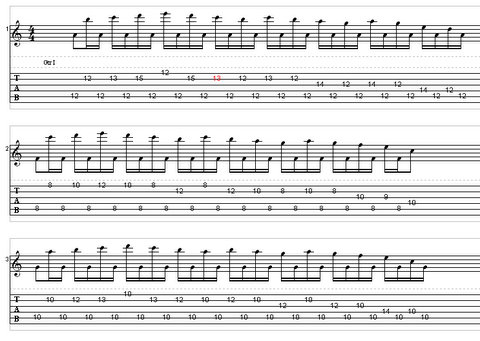
The traditional way is to use the index finger of the right hand (reverse for lefties) to tap down on the high notes and typically have two notes in the left hand that your hammer on and pull off. Your first finger on the left hand is holding down the C on the G string as in the example below.
The first example is the traditional triplet (or sextuplet) tapping pattern in the style of Eddie Van Halen. Notice how easy it is to form a chord between the three notes and then change chords. The chords below go from a C major to C#5 to C6 to Cdom7 by changing one note at a time in the right hand.
learn everything about guitar, tapping playing strumming, chords, arpeggios, notes, songs
Saturday, January 15, 2011
Tuesday, January 4, 2011
Layering guitars in recording studio tracks.
Hello guitarists, just wanted to remind you about some very simple techniques that are sometimes easy to overlook in your recordings. The concept of layering for effect will open up a whole new window to expand your playing.
Now the thought here is not to layer 50 million different guitars until you hear nothing but static on the tape. Just one additional guitar is enough to completely transform your sound. During the recording of my latest guitar piece, "Galactic Winds" I did the simplest thing and it sounded great. The melody line I had come up with just not sounding thick enough, so I played the same exact part an octave higher and that created the "outer space" sound I was looking for.
What I realized is this gives you a way to play more melodically and you have to cooperate with the "harmony guitar". So you'll definitely have to construct your parts a little more carefully knowing you will have to play the exact part again an octave higher or even a third higher.
This is one of my favorites, harmonizing by thirds and sixths. Let's say the lead guitar one is playing the notes C D E in quarter notes, you can harmonize that with lead guitar two in simple thirds with the notes E F G or sixths with the notes A B C. In this example, you are simply playing parallel thirds or sixths which works as long as the key stays the same.You should try this just for an experiment by recording lead guitar one and lead guitar two in patterns and rhythms of your choosing and try harmonizing in different intervals.
Here's the kicker, you can technically harmonize with ANY interval: unison, seconds, thirds, fourths, etc.
Now the thought here is not to layer 50 million different guitars until you hear nothing but static on the tape. Just one additional guitar is enough to completely transform your sound. During the recording of my latest guitar piece, "Galactic Winds" I did the simplest thing and it sounded great. The melody line I had come up with just not sounding thick enough, so I played the same exact part an octave higher and that created the "outer space" sound I was looking for.
What I realized is this gives you a way to play more melodically and you have to cooperate with the "harmony guitar". So you'll definitely have to construct your parts a little more carefully knowing you will have to play the exact part again an octave higher or even a third higher.
This is one of my favorites, harmonizing by thirds and sixths. Let's say the lead guitar one is playing the notes C D E in quarter notes, you can harmonize that with lead guitar two in simple thirds with the notes E F G or sixths with the notes A B C. In this example, you are simply playing parallel thirds or sixths which works as long as the key stays the same.You should try this just for an experiment by recording lead guitar one and lead guitar two in patterns and rhythms of your choosing and try harmonizing in different intervals.
Here's the kicker, you can technically harmonize with ANY interval: unison, seconds, thirds, fourths, etc.
Sunday, January 2, 2011
Minor Ninth Chord Guitar Fingerings
"Minor Ninth" chords present an interesting challenge on guitar because the ninth is so close to the root and third. You have to make some choices about where you place the 9th or the 3rd and whether to omit another a particular chord tone.
First, lets look at the structure of the chord. Am9 chord is spelled A C E G B.
This first example is my all time favorite voicing because the clash of the 9th (B on the G string) and 3rd (C on the B string). This is the "A" form that can be taken up the neck. The example shows 2 chords at once: Am9 and Em9. This does require a little stretch but is essential if you want the dark sounding tension between the 3rd and 9th. This voicing is omitting the 7th scale degree (G) but there are several ways to add that G in or substitute another note.
For example, just at the G on the E string in the Am9 chord. Since the bass player is playing the root already.
.
First, lets look at the structure of the chord. Am9 chord is spelled A C E G B.
This first example is my all time favorite voicing because the clash of the 9th (B on the G string) and 3rd (C on the B string). This is the "A" form that can be taken up the neck. The example shows 2 chords at once: Am9 and Em9. This does require a little stretch but is essential if you want the dark sounding tension between the 3rd and 9th. This voicing is omitting the 7th scale degree (G) but there are several ways to add that G in or substitute another note.
For example, just at the G on the E string in the Am9 chord. Since the bass player is playing the root already.
.
Saturday, January 1, 2011
Tapping Exercise #1 Edge of Pick
Here is an exact riff (shortened) from my latest track called "Heartbeat of the City". I tap the high notes with the edge of the pick for better control. Start by picking the high B note on the B string then pick the D on the E string on the 10th fret. Hammer on the E and F# on the E string.
Now here is the key to this riff. Keep your your 4th finger (pinky) down on the F# on the E string and simultaneously tap with the edge of the pick on the high G on the E string. You do the Tap and release twice. When you bounce back up with the edge of the pick it sounds the F# on the E string because your 4th finger is still holding down the note. This allows you to do a lightning fast bounce between the two notes.
Learning the notes on the guitar.
Hello and Happy New Year to all you guitar advocates! One of the tricky things about guitar is the notes are harder to visualize than say a piano keyboard. Whether you are beginner or advanced, you will need to memorize the notes cold up and down the entire fretboard.
The best way is to start from any open sting and learn each fret one at a time all the way up the neck. The good news is you really only have to memorize up to the 12th fret and the notes repeat from there. For example starting from the open high E string, go up one fret at a time - E F F# G G# A Bb B C C# D D# E, and so on. Repeat this on each string. Over time you will simply memorize that the 3rd fret on the E string is G and the 5th fret is A, etc.
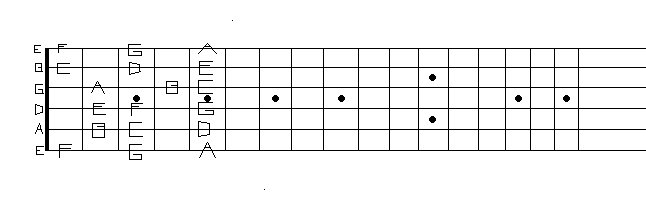
Here is an example where I wrote out the first few notes on the neck, not including sharps and flats.
Here is an example of a "blank fretboard" so you can print it out and chart all the notes for yourself.
Next you can try different ways to challenge your knowledge of the fretboard.
1) Pick any note like F#, for example, and as quickly as you can, play an F# on every string.
2) Pick a fret, for example the 10th fret, and know each note across every string.
.
The best way is to start from any open sting and learn each fret one at a time all the way up the neck. The good news is you really only have to memorize up to the 12th fret and the notes repeat from there. For example starting from the open high E string, go up one fret at a time - E F F# G G# A Bb B C C# D D# E, and so on. Repeat this on each string. Over time you will simply memorize that the 3rd fret on the E string is G and the 5th fret is A, etc.
Here is an example where I wrote out the first few notes on the neck, not including sharps and flats.
Here is an example of a "blank fretboard" so you can print it out and chart all the notes for yourself.
1) Pick any note like F#, for example, and as quickly as you can, play an F# on every string.
2) Pick a fret, for example the 10th fret, and know each note across every string.
.
Tuesday, December 14, 2010
Pedal Tone With Melody
This is a good exercise for keeping a "pedal tone" note in the bass while playing a melody at the same time.
Start by barring at the 12th fret from the A string. Keeping the bar down for the entire exercise creates a temporary capo that shifts up and down. Let the notes ring out and overlap in the high strings. Keeping the bar down solidly will help with this.
Wednesday, December 8, 2010
C Major 7 Arpeggio
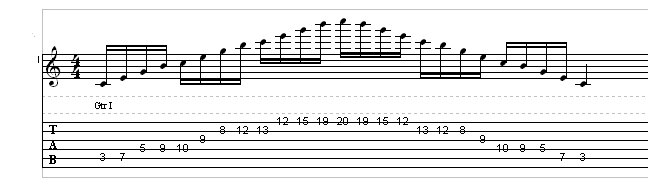
This Arpeggio is good because it covers almost all of the neck. Start on the C on the A string with the 1st finger, and quickly slide up to 7th fret with your 3rd finger. This puts your first finger in position to play the E on the D string.
Subscribe to:
Comments (Atom)